Sunday, 7 October 2012

Local elections across BiH; more controversy in Srebrenica

Srebrenica is, once again, the centre of attention across BiH.
(Source: AdvocacyNet.org)
As citizens across all of Bosnia and Herzegovina took to polling booths today in local elections, most of the  nation's attention has focussed on a bitter electoral dispute in the municipality of Srebrenica.

Much division has been caused across the country after electoral processes were altered in Srebrenica - which not only removed voting rights from Bosnian Muslims (Bosniaks) previously expelled from the area, but also allowed for local Serbians to run for office for the first time since the town's infamous genocide 17 years ago.
In July 1995, Bosnian Serb forces killed more than 8,000 Bosniak men and boys in Srebrenica, and expelled the remainder of the Muslim population.

Until today, the expelled had the right to vote in Srebrenica despite living elsewhere. New rules, however, stipulate that only those living in the town may now vote.

Furthermore, the municipality's mayoral position has been opened up to local Serbian candidates wishing to be elected.

Srebrenica is part of Bosnia's autonomous Serb Republic, whose president, Milorad Dodik, has repeatedly denied that genocide took place.

Many Bosniaks across the nation are concerned that, if one of Dodik's mayoral candidates wins into office in Srebrenica, efforts to keep alive the memory of the 1995 crime will be jeopardised. 

"This is not about the two ethnic groups," said Camil Durakovic, one of the Bosniak candidates for mayor. "This is about two groups of the Bosnian citizens - those who recognise the genocide and those who deny it."

The mayor and local council elected in Srebrenica will be responsible for the mass memorial complex at Potocari - built to remember the victims of the massacre - amongst other things.

Today's elections were conducted in 136 municipalities across BiH, and are the first to take place in the country since the general elections of 2010. In that year, it took 15 months before the winners of those polls managed to form a government.

Hopefully, for all involved, these elections will be a little bit simpler. 

Thursday, 4 October 2012

Around 1,000 students protest closure of Sarajevo's National Museum

Students, upset at the decision to close the city's National
Museum, march through the streets of Sarajevo carrying
a banner reading, 'Shame on you!'
(Source: Klix.ba)

Close to a thousand youths protested in Sarajevo today upon the closure of the city's National Museum.

Students from the University of Sarajevo gathered outside the building this afternoon to vent their frustration at the decision to shut-down the Museum, which has been in operation for 125 years.

After months of disputes over funding, the decision was finally made several weeks ago to officially close the institute; causing much anger and division amongst Bosnians.

Carrying banners labelled with slogans such as, 'Shame on you!' and 'We will not give you our cultural institutions!', the students marched from the Museum to the steps of the Parliament of Bosnia and Herzegovina (BiH), before eventually making their way to the Presidency of BiH.

The president of the Students' Parliament at Sarajevo University, Ahmed Nurkovic, said that the rally was designed to show that these decisions have an impact on the country's youth.

"We invited the students to give support to the Museum and to send the message that we will not allow the aggressors to destroy our cultural institutions," Nurkovic said. "When they destroy the culture, they destroy the people of Bosnia and Herzegovina. We cannot allow the aggressors from '92 to continue destroying us today.

"Although they are without work and without hope, we want to send the message that young people care about these things."

The Museum's doors are shut after 125 years of operation.
(Source: Klix.ba)
Adnan Busuladzic, the director of the National Museum, was brought to tears when addressing the crowd of protesters; thanking them for their support.

"The Museum has always been there for you, but we were forced to take this step," he said. "I don't want to hide my emotions, especially because I can see my students among you. I am touched by your visit."

Busuladzic directed his anger at the government, accusing them of forcing the Museum's closure.

"I know that you understand this situation because you are all educated, young people," he said. "The problem is that this country is led by total primitives and idiots."

Staff will continue to review the Museum's collection each week, although they remain concerned for its condition due to the fact electricity is likely to be switched off.

The National Museum of Bosnia and Herzegovina has been in operation in Sarajevo since 1888.

Vedran Puljic, 3 years on

Vedran Puljic.
Today's date marks three years since the death of innocent FK Sarajevo football supporter Vedran Puljic on an away match in Siroki Brijeg.

On the 4th of October in 2009, Puljic was travelling with Sarajevo's well-known fan group 'Horde Zla' to the south-western Bosnia-Herzgovina town.

Although the details of what exactly occurred are somewhat sketchy, trouble began to break out before the match between the Sarajevo supporters and locals - who are mostly of Catholic-Croatian descent.

During the unrest, locals - possibly with the help of police - began firing on the Sarajevo fans with automatic weapons. Consequentially, 24-year-old Puljic was struck and killed.

Still, to this day, no man has been made responsible for his death.

Furthermore, investigations into the entire incident have been farcical at best. Oliver Knezovic, a Siroki Brijeg local, was a key suspect in the killing. Upon his arrest in the days following the incident, Knezovic somehow made an 'escape' from custody, before fleeing to Zagreb in Croatia; where he remains a free man.

Another possible suspect is local policeman Dragan Vujovic, who was found to test positive for gunpowder residue on the day of Puljic's shooting. Although Vujovic argued that the residue was a result of coming into contact with fireworks used by supporters on that day, media reports claim that the policeman has failed a polygraph test in relation to the incident.

Calls are continuing from people all over the country - and even the world - for justice to be achieved. They are asking for the truth to come out; for someone to be punished for the death of this young man.

It is a sad indictment on the nation's judicial system when cases like this remain unsolved for this amount of time.

As is written on walls all across the capital of Sarajevo: 'Istina za Vedrana', or Truth for Vedran!


Click here: Police footage of the incident in Siroki Brijeg.

Photos:


Puljic, circled, moments before being shot.
Puljic, circled, laying on the ground after being shot. Arrows
purporting to show someone holding pistol.
Thousands mourned Vedran at his
funeral in Sarajevo.
Bitter cross-town rival supporters from Zeljeznicar also
provided their support; organising a march the day after
the shooting to honour Vedran.
Supporters from all over the world, including in Melbourne,
provided their support to Vedran.
'Truth for Vedran'; this stencil graffiti cannot be missed across
all of Sarajevo.

Wednesday, 3 October 2012

Fact of the Day: Bosnian-style

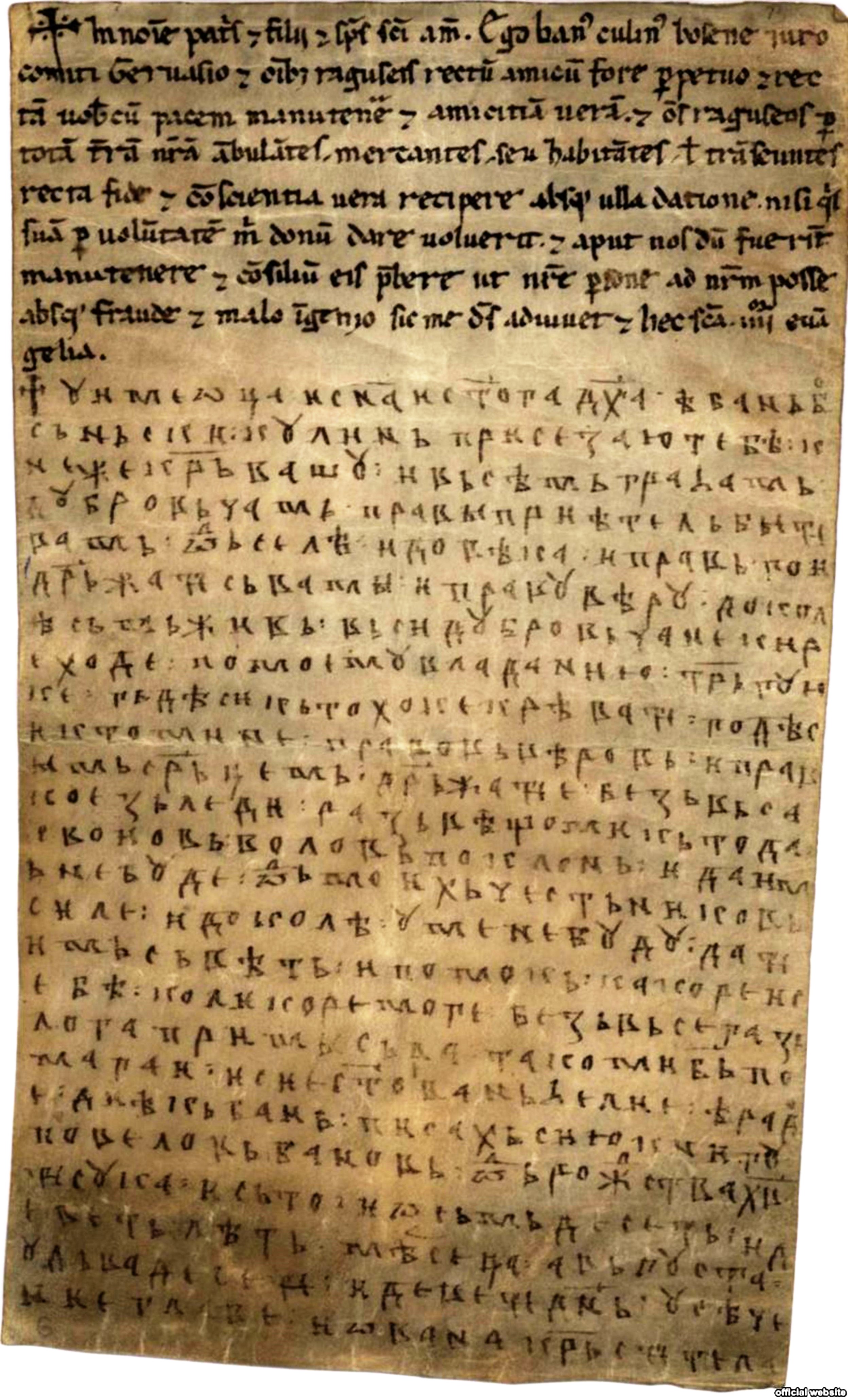
The Charter of Ban Kulin.
(Source: Wikimedia.org)
Many people consider the birth of Bosnia as dating back to August 29, 1189; as it is on this day in which the Charter of Ban Kulin was signed. 

The Ban Kulin Charter - written in Bosnian Cyrillic - was a trade agreement between the Kingdom of Bosnia and the Republic of Ragusa (Dubrovnik), and is one of the oldest written state documents in the Balkans. As a result, the charter is very significant to the national pride and historical heritage of Bosnia. 

------------

A translation of the Ban Kulin Charter below, thanks to W. Browne:


"In the name of the Father and of the Son and of the Holy Ghost. I, Kulin, ban of Bosnia, swear to be a true friend to you, o prince Kr'vash, and to all Dubrovnik citizens from now on and forever, and to keep true peace with you, and true faith, as long as I am alive. All Dubrovnik people who go through my domain trading, wherever anyone wants to move or wherever anyone passes, I will in true faith and with a true heart keep without any damage, unless someone of his own will gives me a gift, and let there be no violence against them by my officers, and as long as they are in my lands I will give them advice and help as I would to myself, as much as I am able, without any evil intention, so help me God and this holy Gospel. I Radoje the ban's clerk wrote this document by the command of the ban, one thousand and one hundred and eighty and nine years from the birth of Christ, the month of August, the twenty-ninth day, [the day of] the beheading of John the Baptist."

Things I'll miss about Bosnia: #3

Impromptu coffees

Rusty's home-made Bosnian (or Turkish, actually) coffee -
this was my first attempt at it a number of months ago in
Sarajevo!
Coffee! Now, come on, when people think of modern-day European culture and lifestyle, they sure as hell think of coffee. Bosnia and Herzegovina is certainly no exception to the rule.

People in this part of the world bleed coffee. (I am serious. I think it is in their blood.) It is a daily 'must-do' for everyone in this country, no matter what age.

I know some people here who probably drink close to ten coffees on some days, no kidding!

When I first arrived to Bosnia, I was probably the furthest from a coffee-connoisseur that you could be. However, now - and somewhat thanks to my partner's insistence - I do not think I could survive without a morning caffeine 'fix'.

I have grown to love the coffee culture that exists in this country.

Rather than being crammed indoors on a computer all day, youths here actually go outside to catch up with friends face-to-face - and coffee is the perfect excuse to do that.

Even those who are a bit older, and who struggle to go outside all the time, are always inviting their friends and family over to their home for coffee.

Unfortunately, such a culture is not so prominent in Australia.

Maybe, once I return home, I will attempt to incorporate this culture into my own lifestyle, as well as those of some of my friends and family (yeah, watch out, guys).

However, in a society, such as Australia, where we tend to communicate with people with technology these days rather than face-to-face, I am unsure of how effective it will be.

That does not mean I cannot try, though!

Just ask my partner, even I can make a decent coffee these days - doesn't mean one of my friends can't!

So, bujrum - or 'welcome' - everyone... Would you like your coffee with or without milk?

Tuesday, 2 October 2012

Things I'll miss about Bosnia: #2

A couple of tickets from Celik matches I have attended over
the last few weeks.

Football


Yes, that's right. One of the things I will miss the most about Bosnia and Herzegovina is attending the football.

Okay, now lets think about it for a second.

This country is not exactly renowned for its quality of football; particularly its domestic competition. Not to mention that, for the majority of local matches, the crowd will not exceed more than a couple of thousand.

Oh, and throw in the fact that many of the people who do actually attend the Bosnian stadiums on game-day  complain of refereeing inconsistency or, better put, corruption.

So, wait a minute. Why would I miss anything about it? Really, it is simple.

Muddy pitches - I love it. (Source: Lupiga.com)
The passion. The atmosphere. The fans. The muddy pitches. The players giving their all for the shirt of their club that has been in existence for decades upon decades; clubs that have 'survived', for want of a better term, a number of wars.

To me, that is football. It is those little things which, really, football would be nothing if it were without them.

If you have been following my blog, no matter to what capacity, most likely you will know that I have some sort of affinity for my local football club Celik Zenica.

Although the club's performances on the pitch have been relatively average this season, and much-so for the past number of years, Celik remains the pride of this city.

Celik Zenica are a club with a long history of success and
passionate support; this is an old photo, though I
am unsure of the exact year.
(Source: Petroley.hubpages.com)
The committed and hardcore fans bleed for this club; though they may not expect titles with their current crop of players, they at least expect those players to put in 100-per-cent effort every time. As long as the players are giving their all, so will their fans - and the atmosphere created by them, at their best, is almost second-to-none.

Although I also have a club in Australia - I support Melbourne Victory - you can notice how sanitised the game can become sometimes; huge modern stadiums; overpaid and 'past-it' players only pulling the boots on for a quick pay-check; sides which are run more like a business rather than an actual football club.


While those factors may define the modern day version of football, myself, and others like me, believe that the game loses much of its soul when it falls into this position.

Upon summation of the aforementioned, I have gradually learned to respect and appreciate the finer things about the sport of football that I am experiencing in the stadiums of this fascinating country - certain things that I wish had not been completely on the game back home in Australia.

The Return of Sarajevo's Historic City Hall

Sarajevo's re-constructed City Hall this week.
(Source: Klix.ba)
After twenty long years, citizens of Sarajevo can finally look at the Bosnian capital's historic City Hall the same way it once stood.

Scaffolding around the building was finally removed this week to reveal the newly re-built Hall, which was destroyed by Serbian artillery fire during the siege of Sarajevo in August 1992.

Before its destruction, the building - originally built in the late 19th century, and locally known as 'Vijecnica' - was a long-standing remnant of the city's Austro-Hungarian past.

Not only that, but Franz Ferdinand, the former Austro-Hungarian Archduke, is famously known to have been present at a 1914 meeting in City Hall before his assassination just minutes later; an incident that let to a chain of events that eventually triggered World War I.

Although the completed exterior-work on City Hall has brought a much-needed facelift to the area, reconstruction and restoration efforts are continuing on the inside of the building.

Officials from Sarajevo's City Administration have estimated that the project should be completed by May 2014.

----

Vijecnica Timeline


Here is how City Hall looked before its 1992 destruction:


Its state following Serbian bombardment:


How it looks now: